
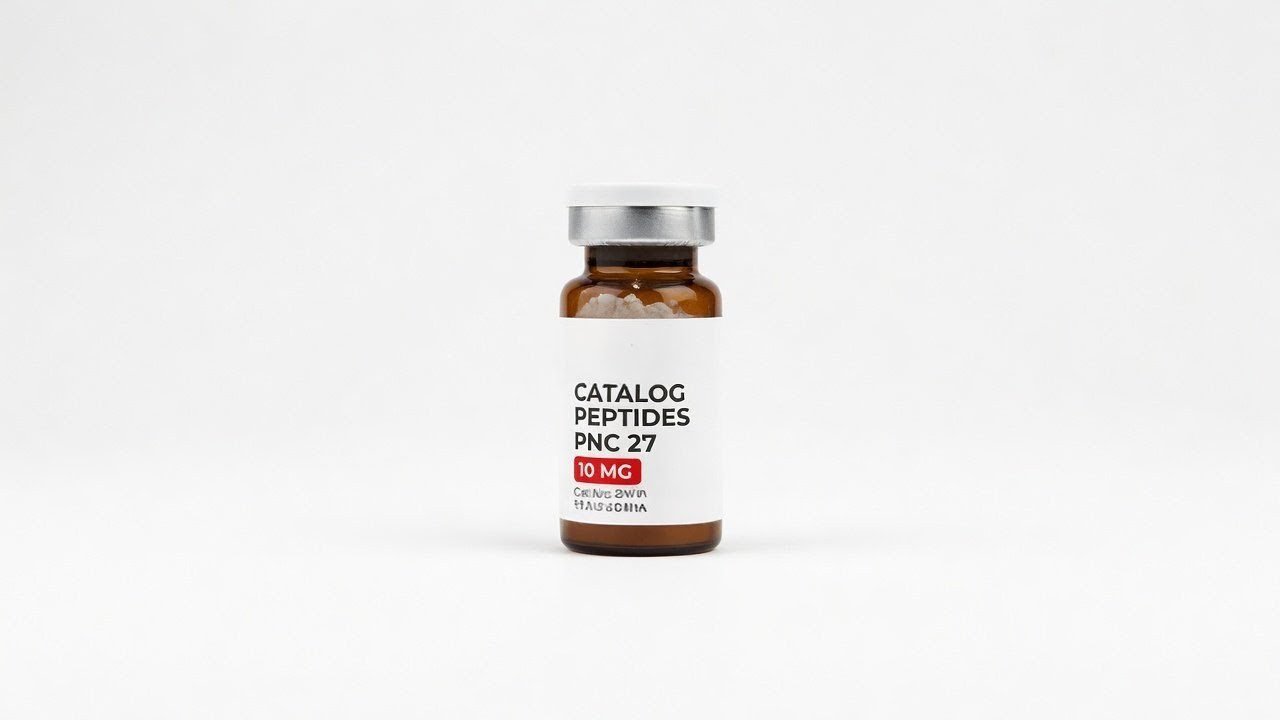
PNC-27: High-Purity Research Peptide for Cancer Cell Studies
Are you searching to buy PNC-27 online from a manufacturer that prioritizes purity and consistency? Peptides Arena supplies research-grade PNC-27, a 27-amino acid peptide that scientists study for its potential to affect cancer cell activity and proliferation in laboratory models.
Below, we cover what PNC-27 is, what current research shows, and why labs choose Peptides Arena when they search for PNC-27 for sale.
What Is PNC-27 Peptide?
PNC-27 comes from the third helix of the α-helical segment of p53 (ASPP2), a protein tied to tumor suppression. Researchers study this peptide because it appears to trigger cell death through necrosis in several cancer cell lines, including pancreatic cancer, ovarian cancer, and leukemia.
Scientists first synthesized PNC-27 in 2000 as part of an HIV-related immunodeficiency research project. During that work, researchers found that the peptide binds with the double minute (HDM2) protein — a protein that appears overexpressed on cancer cell membranes.
How PNC-27 Appears to Work
Unlike many anticancer research compounds that trigger apoptosis, PNC-27 seems to act differently. Instead, it appears to physically disrupt the plasma membrane by forming pores, a process researchers call membranolysis. This disruption allows ions to flow in and cellular contents to flow out, which ultimately leads to cell death.(1)
Chemical Makeup of PNC-27
| Property | Detail |
|---|---|
| Molecular Formula | C188H293N53O44S |
| Molecular Weight | 4031.7 g/mol |
PNC-27 Peptide Benefits in Research: What Studies Show
When researchers explore PNC-27 peptide benefits in laboratory settings, they’re typically referring to its research applications in selective cancer cell targeting. Here’s what the published studies reveal so far.
PNC-27 and Selective Cell Death
A 2009 study set out to determine whether PNC-27 might interact with non-cancerous cells.(2) Researchers proposed that PNC-27 binds specifically with HDM-2 protein, which appears present only in cancerous cells. Using conformational energy calculations and immuno-electron microscopy, the team observed ring-shaped pore structures at the cancer cell surface — structures that did not appear in normal cells exposed to the same peptide.
To test this selectivity further, researchers implanted normal cells with HDM-2 protein. Once modified, these cells suddenly showed affinity for PNC-27, reinforcing the idea that HDM-2 binding drives the peptide’s targeting behavior.
PNC-27 and Lysis of Cancerous Cells
A 2010 study examined whether the intact peptide, rather than peptide fragments, drives membrane pore formation.(3) Researchers labeled PNC-27 with green and red fluorescent markers on opposite terminal ends, then exposed breast tumor cells and control cells to the modified peptide.
Thirty minutes later, a bright yellow luminescence appeared during membrane lysis — a sign the peptide remained fully intact throughout the process. This effect appeared only in cancerous cells, while control cells stayed viable. Researcher Kelley A. Sookraj and colleagues explained that PNC-27 interacts with intramembrane targets found in cancer cells but absent in untransformed cells, which extends the peptide’s active lifetime specifically at cancer cell membranes.(3)
PNC-27 and Non-Solid Tumor Cells
A 2014 study shifted focus toward non-solid tissue tumor cells, investigating whether these cells also express HDM-2 and whether PNC-27 could induce necrosis through the same membrane-binding mechanism.(4) Researchers exposed non-solid tumor cells to PNC-27 while using murine leukocyte cells as a control.
The results suggested HDM-2 expression in the non-solid tumor cells, and PNC-27 again showed selectivity toward these cells. Researcher Katlin Davitt and colleagues noted that because K562 leukemia cells lack p53 expression, PNC-27’s effects on this cell line may occur through a p53-independent pathway.(4)
PNC-27 and Related Peptide Research
A related study examined PNC-28, a peptide structurally and functionally similar to PNC-27.(5) Researchers tested PNC-28 against ovarian cancer cells and mouse xenograft models, and it appeared to inhibit ovarian cancer cell growth while reducing tumor size in the mouse models.
A 2020 study also examined PNC-27’s potential against non-stem cells from several acute leukemia cell lines, including U937, OCI-AML3, and HL60.(6) Researchers selected these lines for their distinct phenotypic and genotypic profiles. After exposure, HDM-2 protein appeared highly expressed across all tested leukemia cells, and PNC-27 appeared to target each one.
Where to Buy PNC-27 Peptide Online
PNC-27 For Sale: What to Check Before You Order
Before you choose a supplier for PNC-27 for sale, confirm they document batch purity, follow validated synthesis methods, and state clear research-use terms. These details protect your data integrity and your compliance standing.
Buy PNC-27 Online from Peptides Arena
Peptides Arena supplies PNC-27 peptide with consistent purity and rigorous internal quality checks on every batch. Whether you’re running a single cell-line study or an ongoing oncology research program, you can order with confidence.
Order PNC-27 Peptide Today
Ready to add PNC-27 to your research pipeline? Peptides Arena makes ordering simple, with fast turnaround and documented quality on every vial.
PNC-27 peptide is available for research and laboratory purposes only. It is not intended for human or veterinary use. Please review and adhere to our Terms and Conditions before ordering.
- Khavinson, V., Linkova, N., Kozhevnikova, E., & Trofimova, S. (2020). EDR Peptide: Possible Mechanism of Gene Expression and Protein Synthesis Regulation Involved in the Pathogenesis of Alzheimer’s Disease. Molecules (Basel, Switzerland), 26(1), 159. https://www.ncbi.nlm.nih.gov/pmc/articles/PMC7795577/
- National Center for Biotechnology Information. PubChem Compound Summary for CID 10273502, Glu-Asp-Arg. https://pubchem.ncbi.nlm.nih.gov/compound/Glu-Asp-Arg
- Eroğlu, O., Karlıdağ, T., Kuloğlu, T., Keleş, E., Kaygusuz, İ., & Yalçın, Ş. (2018). The Protective Effect of Cortexin on Cisplatin-Induced Ototoxicity. The journal of international advanced otology, 14(1), 27–33. https://www.ncbi.nlm.nih.gov/pmc/articles/PMC6354512/
- Khavinson V, Ribakova Y, Kulebiakin K, Vladychenskaya E, Kozina L, Arutjunyan A, Boldyrev A. Pinealon increases cell viability by suppression of free radical levels and activating proliferative processes. Rejuvenation Res. 2011 Oct;14(5):535-41. https://pubmed.ncbi.nlm.nih.gov/21978084/
- Meshchaninov VN, Tkachenko EL, Zharkov SV, Gavrilov IV, Katyreva Iue. EFFECT OF SYNTHETIC PEPTIDES ON AGING OF PATIENTS WITH CHRONIC POLYMORBIDITY AND ORGANIC BRAIN SYNDROME OF THE CENTRAL NERVOUS SYSTEM IN REMISSION. Adv Gerontol. 2015;28(1):62-7. Russian. PMID: 26390612. https://pubmed.ncbi.nlm.nih.gov/26390612/
- Khavinson VKh, Kuznik BI, Tarnovskaya SI, Lin’kova NS. Short Peptides and Telomere Length Regulator Hormone Irisin. Bull Exp Biol Med. 2016 Jan;160(3):347-9. doi: 10.1007/s10517-016-3167-y. Epub 2016 Jan 8. PMID: 26742748. https://pubmed.ncbi.nlm.nih.gov/26742748/
- Homocysteine. https://my.clevelandclinic.org/health/articles/21527-homocysteine
- Arutjunyan, A., Kozina, L., Stvolinskiy, S., Bulygina, Y., Mashkina, A., & Khavinson, V. (2012). Pinealon protects the rat offspring from prenatal hyperhomocysteinemia. International journal of clinical and experimental medicine, 5(2), 179–185. https://www.ncbi.nlm.nih.gov/pmc/articles/PMC3342713/
| PNC 27 | 5mg*10vials, 10mg*10vials |
|---|
1 review for PNC 27
Related products
All Peptides
All Peptides
All Peptides
All Peptides
All Peptides
All Peptides
All Peptides
All Peptides
Flores –
Excellent communication throughout. Delivery came as described and sooner than anticipated! Will definitely be using again.